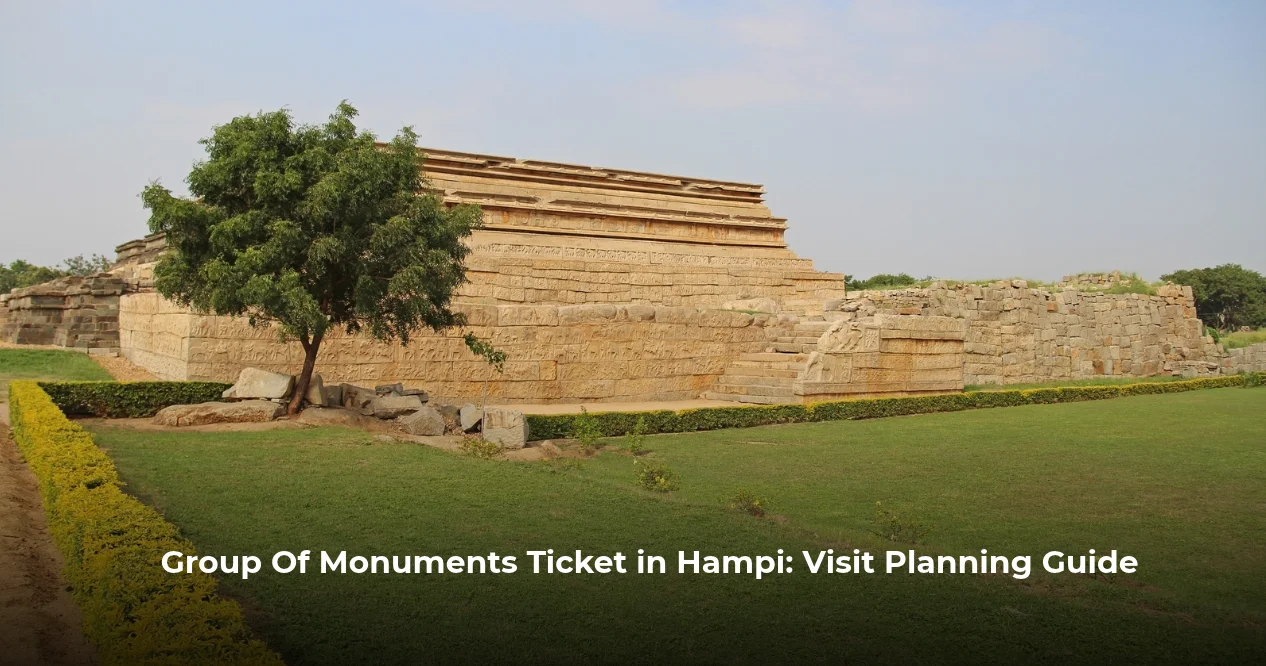
The Group Of Monuments Ticket in Hampi is the practical starting point for travellers exploring some of the most celebrated protected sites in the UNESCO World Heritage landscape of Hampi, Karnataka. This remarkable former capital of the Vijayanagara Empire spreads across a dramatic terrain of granite boulders, temple ruins, ceremonial spaces and riverine scenery near Hospet in southern India.
Rather than functioning as a single enclosed attraction, the ticket relates to major archaeological complexes managed by the Archaeological Survey of India. The best-known ticketed highlights are generally the Vittala Temple complex, famed for its Stone Chariot and ornate pillars, and the Royal Enclosure area, where visitors can see the Lotus Mahal, Elephant Stables and other remains connected with royal life in Vijayanagara-era Hampi.
What the Group of Monuments in Hampi Is
Hampi was the prosperous imperial centre of the Vijayanagara Empire between the fourteenth and sixteenth centuries. Its surviving monuments reveal a city shaped by religion, trade, royal ceremony and sophisticated water management. The ticketed zones offer a focused introduction to this vast archaeological setting, where carved mandapas, gateways, pavilions and palace-era structures stand against a striking boulder-strewn horizon.
The experience is primarily outdoors and involves walking between structures rather than following a fixed museum route. Visitors should expect open courtyards, exposed stone pathways, limited shade in places and an atmosphere that feels more like an archaeological landscape than a conventional attraction.
Main Highlights Included in a Hampi Monument Visit
Vittala Temple and the Stone Chariot
The Vittala Temple complex is among Hampi’s most visually memorable sites. Its celebrated Stone Chariot is an iconic symbol of Karnataka tourism, while the surrounding temple architecture rewards slow observation. Look closely at the carved columns, decorative friezes, monumental gateways and the scale of the market street leading towards the complex.
Royal Enclosure and Mahanavami Dibba
The Royal Enclosure preserves traces of Hampi’s political and ceremonial heart. The Mahanavami Dibba, a large ceremonial platform with carved reliefs, offers valuable context for understanding imperial festivals and courtly processions. Although many palace buildings no longer survive, foundations, water structures and platforms help visitors imagine the scale of the former royal precinct.
Lotus Mahal and Elephant Stables
The Lotus Mahal is admired for its graceful arches and distinctive blend of architectural influences. Nearby, the Elephant Stables form an impressive row of domed chambers once used for royal elephants. Together, these structures are among the most accessible and photogenic examples of secular architecture in Hampi.
How to Plan Your Visit
Start by deciding whether you want a compact visit focused on the main ticketed sites or a fuller day exploring Hampi’s sacred, royal and riverside areas. The Vittala Temple complex and the Royal Enclosure are not beside each other, so transport planning matters. A taxi, auto-rickshaw, hired bicycle or scooter can save energy, especially during warm weather.
It is sensible to visit the more exposed areas early, then schedule a break during the hottest part of the day. The exact ticket price, eligibility categories, payment methods, opening schedule and any entry restrictions should be confirmed before travel. Check the official website for the latest updates, particularly around public holidays, conservation work and seasonal operating changes.
Travellers using the referenced Group Of Monuments Ticket in Hampi product should read the supplier’s current inclusions and redemption instructions carefully before arrival. This is especially important because Hampi contains multiple monument clusters, some religious sites follow separate customs, and local transport is usually arranged independently unless clearly stated in the booking details.
Tickets, Timing and Entry Guidance
Hampi’s principal protected monuments are administered within a heritage landscape where ticketing can differ by site and visitor category. Published rates, operating hours and accepted payment options may change, so it is better to avoid relying on old travel posts or screenshots. Check the Archaeological Survey of India information, current on-site notices and the conditions attached to your chosen booking product before setting out.
Arriving shortly after opening generally creates the most comfortable sightseeing conditions. The early light also flatters the stone carvings and gives you more time to move between complexes without rushing. Late afternoon can be beautiful too, but do not leave major walking routes or transport arrangements until the last minute.
Best Photo Spots in the Hampi Group of Monuments
The Stone Chariot at the Vittala Temple is Hampi’s classic image, but the most satisfying photographs often come from stepping back to include the surrounding temple architecture and rocky landscape. The approach along Vittala Bazaar can create strong leading lines, while the outer edges of the complex provide wider views when visitor movement permits.
At the Royal Enclosure, the Elephant Stables are especially effective for symmetrical compositions. The Lotus Mahal is best photographed with patience, allowing space around its arches and avoiding intrusive crowds where possible. Respect barriers, avoid climbing on protected structures and follow photography restrictions posted at individual sites.
Transport and Arrival Advice
Most visitors reach Hampi from Hospet, the nearest major transport hub with rail connections and a wider range of accommodation. From Hospet, taxis and auto-rickshaws are commonly used for the road journey to Hampi. Once in the heritage area, distances between monuments can be greater than they appear on a map, especially in hot conditions.
Agree on a transport plan before beginning your visit. If using an auto-rickshaw or taxi for several stops, clarify the route, waiting time and return journey in advance. Scooters and bicycles can work well for confident riders, but road conditions, heat and uneven surfaces should be considered carefully.
Accessibility and Family Planning
Hampi’s monumental landscape is inspiring but not uniformly accessible. Some areas have level approaches, yet many routes involve uneven stone, gravel, steps, exposed ground and long distances without shade. Visitors with limited mobility may find a private vehicle, a flexible itinerary and assistance from travelling companions helpful.
Families can have an excellent experience when they keep the pace realistic. Bring drinking water, sun protection, snacks and footwear suitable for rough ground. Young children should remain close to adults, particularly around ancient steps, elevated platforms, boulder formations and areas with limited railings.
Common Mistakes to Avoid
- Trying to cover every Hampi monument in a few rushed hours.
- Beginning the main walk during the hottest part of the day.
- Assuming all temples and archaeological sites use the same entry rules.
- Relying on outdated ticket prices or opening-hour information.
- Arriving without a clear plan for transport between monument clusters.
- Wearing slippery footwear on uneven stone paths.
- Climbing on walls, platforms or protected carvings for photographs.
- Forgetting that shade and food options can be limited near some complexes.
Visitor Tips
- Start early to enjoy softer light and lower temperatures.
- Carry refillable water bottles and drink regularly in the dry heat.
- Wear sturdy shoes with grip for stone paths and uneven surfaces.
- Use sunscreen, a hat and breathable clothing throughout the year.
- Keep cash and digital payment options available for local transport and small purchases.
- Download offline maps because mobile coverage can vary around the ruins.
- Allow extra time for walking, photography and rest stops.
- Respect signage, barriers and conservation instructions at every monument.
- Confirm current ticket conditions directly from official channels before travel.
- Arrange a return ride before the day’s final sightseeing stop.
Nearby Things to Do
- Visit Virupaksha Temple near Hampi Bazaar for one of the area’s most active and historic sacred sites.
- Walk through the Hampi Bazaar and take in views towards Matanga Hill.
- Explore the riverside setting around the Tungabhadra River and nearby temple remains.
- Climb Matanga Hill at an appropriate time for expansive views across the boulder landscape.
- Visit the Archaeological Museum at Kamalapura for added historical context before or after the ruins.
Travellers building a wider Karnataka itinerary can make their days more efficient by grouping Hampi’s principal complexes with nearby cultural experiences and transport arrangements. The tripXOXO CITY Pass can be worth considering when its current inclusions align with the attractions and activities you genuinely plan to visit, rather than adding stops simply to fill an itinerary.
Conclusion
The Group Of Monuments Ticket in Hampi opens the door to one of India’s most evocative heritage landscapes. With early planning, comfortable footwear, realistic pacing and verified ticket information, visitors can appreciate the artistry of the Vittala Temple, the grandeur of the Royal Enclosure and the unforgettable setting that makes Hampi a UNESCO World Heritage Site.
Location: Hampi, Karnataka, India, within the UNESCO-listed Hampi Group of Monuments landscape near Hospet.
Recommended duration: Allow at least half a day for the main ticketed complexes, or a full day when combining them with Hampi Bazaar, Virupaksha Temple and riverside viewpoints.
Best time to visit: October to February is generally more comfortable for walking. Start early in the morning or visit later in the afternoon to avoid the strongest heat.
Getting there: Hampi is usually approached from Hospet, around 13 kilometres away. Visitors can use taxis, auto-rickshaws, hired scooters, bicycles or local transport depending on the monument area.
Accessibility: Some key approaches are relatively level, but historic stone paths, uneven ground, steps and heat can make independent access challenging in several areas.
Family friendliness: Hampi is rewarding for families who plan around shade, water breaks and short walking sections. Close supervision is important around boulders, steps and unfenced archaeological features.
Frequently Asked Questions:
Q) How can travellers combine Hampi monuments with other attractions?
A) A well-paced Hampi day can combine the ticketed monument complexes with nearby sacred and riverside landmarks. The tripXOXO CITY Pass may help travellers organise eligible experiences in one broader plan. Compare its current inclusions with your route, transport needs and available sightseeing time before booking.
Q) Do I need cash for a Hampi visit?
A) Digital payments are increasingly common, but cash remains useful for local transport and small purchases. Connectivity and payment acceptance can vary across the wider heritage area. Carry a modest amount of cash while keeping valuables secure and distributed safely.
Q) Can attraction passes help save money during a Hampi visit?
A) Savings depend on which attractions and services are actually included in a pass. The tripXOXO CITY Pass may offer value when its available benefits suit a multi-experience Hampi itinerary. Review the latest terms carefully, since separate monument tickets, transport and guide services may have different conditions.
Q) How should visitors plan multiple experiences around Hampi?
A) Start with the major ticketed monuments, then add nearby sites according to daylight and transport availability. The tripXOXO CITY Pass can support itinerary planning when its current selection fits your intended experiences. Avoid scheduling too many distant stops because Hampi is best enjoyed at an unhurried pace.
Q) What does the Group Of Monuments Ticket in Hampi cover?
A) The ticket is associated with important protected archaeological areas in Hampi. Prominent sites commonly connected with the main monument visit include the Vittala Temple complex and Royal Enclosure landmarks. Confirm the exact current inclusions through the official source or your booking provider before arriving.
Q) Where are the ticketed Hampi monuments located?
A) The principal ticketed monuments are spread across the Hampi heritage zone in Karnataka. Vittala Temple lies near the eastern side of the main settlement area, while the Royal Enclosure is closer to Kamalapura. Transport between these areas is useful because they are not adjacent.
Q) What time should I arrive at Hampi monuments?
A) Morning is usually the most comfortable time for exploring the exposed archaeological sites. Early arrival provides cooler temperatures and gentler light on the stone architecture. Check current operating hours before travelling, as official schedules and access arrangements can change.
Q) Are Hampi monument ticket prices fixed?
A) Ticket prices can vary by visitor category and are subject to official revision. Older blogs may not reflect current charges or payment procedures. Check the Archaeological Survey of India information and the ticket counter guidance for the latest verified details.
Q) Can I buy Hampi monument tickets online?
A) Online availability and booking procedures may change depending on the site and operator. Some visitors use authorised travel products, while others purchase according to current on-site arrangements. Read all redemption instructions carefully and check official updates before relying on a particular method.
Q) Is a guide useful at the Group of Monuments in Hampi?
A) A knowledgeable guide can make the ruins more meaningful by explaining imperial history, architectural details and ceremonial spaces. Independent visitors can still enjoy the sites with a map and background reading. Choose an authorised or well-reviewed guide and agree on the route before beginning.
Q) How do I travel from Hospet to Hampi?
A) Hospet is the usual gateway for visitors arriving by train or longer-distance bus. Taxis and auto-rickshaws commonly make the short road journey to Hampi. Confirm the fare, waiting arrangement and return plan before leaving Hospet, especially for an early start.
Q) What nearby landmark helps orient visitors in Hampi?
A) The Tungabhadra River, Hampi Bazaar and Virupaksha Temple are useful reference points in the central heritage area. Kamalapura is another practical landmark near the Royal Enclosure and museum. Offline maps help because the ruins are spread across a broad landscape.
Q) Is Hampi suitable for visitors with limited mobility?
A) Some areas can be viewed with relatively short walks, but the overall terrain is challenging. Uneven paths, loose surfaces, steps and historic stonework are common throughout the landscape. A private vehicle, companion assistance and flexible expectations can make the visit more manageable.
Q) Can families visit the Group of Monuments in Hampi?
A) Families often enjoy Hampi because the ruins feel expansive and visually dramatic. Children need regular water breaks, sun protection and careful supervision near uneven surfaces. Plan a shorter route if travelling with young children, particularly during warmer months.
Q) What should I wear when visiting Hampi?
A) Light, breathable clothing is sensible because much of the visit takes place outdoors. Closed shoes with secure grip are better than sandals on worn stone and irregular paths. A hat, sunglasses and sunscreen add important protection during daylight hours.
Q) Is photography allowed at Hampi monuments?
A) Photography is a major part of the Hampi experience, particularly around the Stone Chariot and Elephant Stables. Restrictions may apply in certain areas or during conservation work. Follow signs, respect barriers and avoid climbing on historic structures for a photograph.
Q) Where are the best photos in the ticketed Hampi sites?
A) The Stone Chariot at Vittala Temple is the most recognisable subject in Hampi. Elephant Stables offer strong symmetry, while the Lotus Mahal creates elegant architectural frames. Early morning and late afternoon usually provide softer light and fewer harsh shadows.
Q) Should I book the Group Of Monuments Ticket in advance?
A) Advance planning can be useful during busy travel periods or when your itinerary is tightly timed. Booking decisions should depend on the provider’s current conditions and the official monument arrangements. Always retain confirmation details and verify the redemption process before travelling.
Q) Are food and water available near the monuments?
A) Food options are not equally available around every archaeological complex. Carry enough drinking water and a small snack, especially when planning a longer route. Eat substantial meals before or after the main monument walks rather than depending on nearby vendors.
Q) Can I visit Hampi during the monsoon?
A) Monsoon conditions can make the boulder landscape greener and more atmospheric. Rain may also create slippery stone surfaces, muddy paths and less predictable travel conditions. Bring suitable footwear, protect electronics and allow extra time for moving between sites.
Q) Are there toilets at the Hampi monument complexes?
A) Visitor facilities can vary between monument areas and may be basic. It is wise to use available facilities before beginning a longer walk. Keep hand sanitiser and tissues with you, particularly when exploring several sites in one day.
Q) Can I visit Virupaksha Temple with the monument ticket?
A) Virupaksha Temple is a living religious site with its own customs and visitor expectations. It should not be assumed that its arrangements are identical to ticketed Archaeological Survey of India complexes. Dress respectfully and check current entry guidance when you arrive.
Q) What should I avoid doing at Hampi monuments?
A) Avoid touching fragile carvings, climbing structures or stepping beyond marked visitor areas. These monuments are protected archaeological remains and can be damaged by careless behaviour. Give yourself enough time so that photographs and transport decisions do not lead to rushed choices.
Q) Can I visit Hampi in one day?
A) One day is enough for a rewarding introduction to the main monument areas. It is not enough to understand every temple, bazaar, viewpoint and archaeological feature in depth. Focus on a few major complexes and return another day if your schedule allows.