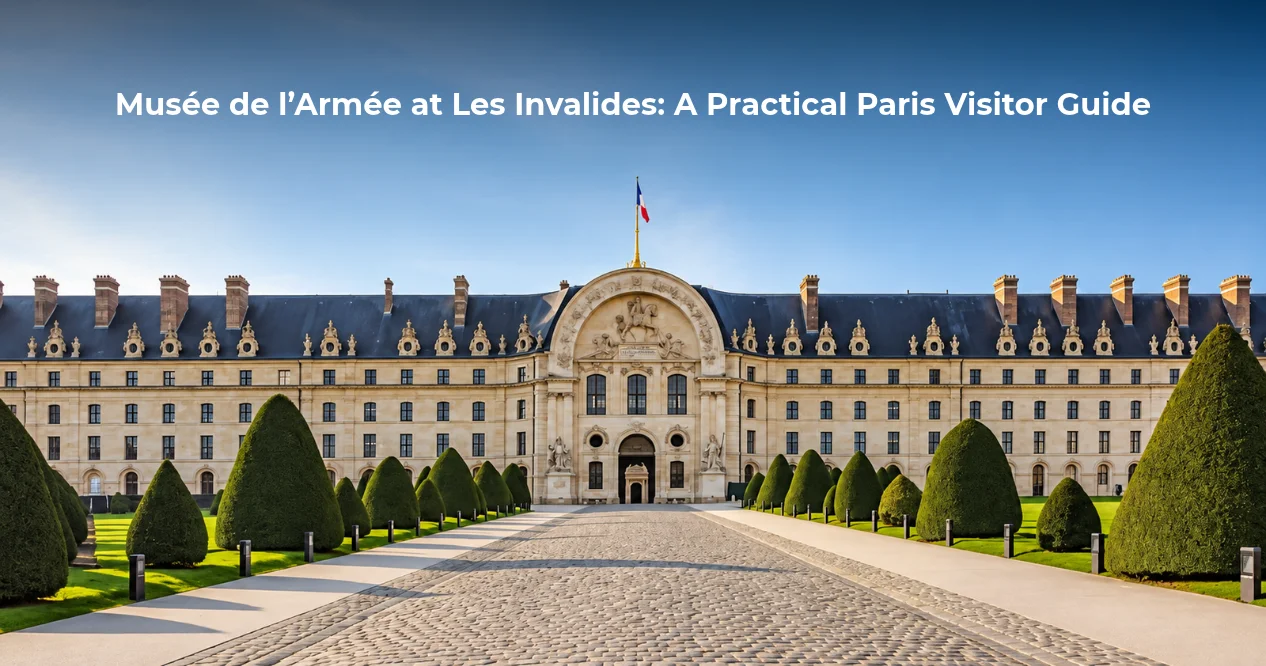
Musée de l’Armée, housed within the monumental Hôtel national des Invalides in Paris’s 7th arrondissement, is France’s leading museum of military history. Often described simply as Les Invalides, this vast historic complex combines grand architecture with collections tracing warfare, soldiers and French history from the Middle Ages through the twentieth century. Its defining landmark is the shining Dôme des Invalides, where Napoleon I’s tomb sits beneath one of Paris’s most recognisable gilded domes.
A priority-entrance booking for Musée de l’Armée - Les Invalides can be a practical choice for travellers with a structured Paris itinerary. It is important, however, to read the confirmation carefully: priority access normally concerns admission arrangements and does not necessarily remove security checks, change museum rules or guarantee a completely empty entrance. Check the official website and your booking confirmation for the latest updates.
What Makes Musée de l’Armée Special
The museum is more than a single gallery of weapons or a quick stop for Napoleon enthusiasts. It occupies the historic Invalides complex founded by Louis XIV as a home for war veterans, and its displays connect objects with the people, conflicts and political changes that shaped France and Europe. The setting itself is central to the experience: ceremonial courtyards, long façades and the dome create a sense of scale before visitors enter the collections.
The museum’s celebrated departments include historic arms and armour, galleries devoted to the seventeenth through nineteenth centuries, and substantial presentations on the two World Wars. Visitors can also encounter military uniforms, artillery, paintings, models, personal objects and documents. The experience works best when treated as a narrative journey rather than an attempt to read every label.
Main Highlights to See
Napoleon I’s Tomb and the Dôme des Invalides
The Dôme des Invalides is the emotional and architectural centrepiece for many visitors. Beneath its richly decorated interior lies the red porphyry sarcophagus of Napoleon I, placed within a circular crypt. Take time to view it from the upper balustrade as well as from floor level, because the changing perspective reveals the scale of the monument and the surrounding sculptural programme.
Historic Arms and Armour
The arms and armour displays are among the museum’s most visually immediate spaces. Elaborate ceremonial armour, swords, muskets and cavalry equipment bring medieval and early-modern military culture to life. Even travellers who do not normally seek out military museums often appreciate the craftsmanship and ornament of these objects.
Modern Warfare Galleries
The galleries covering the First and Second World Wars add a more intimate, reflective dimension. They explore France’s experience of conflict through uniforms, personal possessions, propaganda, equipment and historical interpretation. Allow extra time here if you are interested in twentieth-century Europe, because these rooms reward slow reading and careful observation.
What to Expect During Your Visit
Expect a large museum with several distinct routes rather than one short linear exhibition. Some visitors arrive chiefly for Napoleon’s tomb and leave in under an hour, but the wider collection deserves considerably more time. A comfortable first visit usually takes two to three hours, while history-focused travellers can spend longer without running out of material.
The mood varies across the site. The grand dome and tomb are ceremonial, the armour rooms are visually dramatic, and the modern-history galleries can be serious and contemplative. Signage and exhibition interpretation help visitors understand the context, though non-specialists may find it useful to choose two or three themes to prioritise rather than trying to absorb every period equally.
How to Plan Your Visit
Begin by choosing a date that fits the rhythm of your Paris stay. The museum is in a highly convenient central location, but its size means it should not be treated as a rushed add-on between several major monuments. An earlier arrival is often more comfortable, particularly if you want unhurried photographs in the courtyard and around the dome.
Ticket availability, pricing and entry arrangements can vary by visitor category, exhibition programme and booking channel. A Musée de l’Armée - Les Invalides priority-entrance product may offer a more streamlined arrival than buying on the day, but inclusions should always be checked before purchase. Official opening calendars and temporary closure notices can change, so check the official website for the latest updates before travelling.
Security screening is part of visiting a major Paris cultural site. Travel light, allow a little time for arrival procedures and keep your booking details accessible on your phone or in printed form. Avoid making tightly timed restaurant, train or airport plans immediately after your visit, especially during busy holiday periods.
Tickets, Timing and Entry Guidance
Admission options can include general museum entry, concessions for eligible visitors and special arrangements connected to exhibitions or events. Rather than relying on an old price quoted in a travel blog, use the official Musée de l’Armée ticketing pages or the terms attached to your priority-entry booking. That approach is particularly important because conditions, opening days and access routes may be adjusted for security, restoration work or programming.
The museum generally operates daytime visiting hours, with seasonal and occasional schedule changes possible. Arriving close to opening often gives the calmest start, while later afternoon visits require discipline because the galleries are extensive. Check the official website for the latest updates on opening times, final admission and any exceptional closures.
Getting to Les Invalides
Les Invalides is positioned between the Seine, the Eiffel Tower area and the Saint-Germain-des-Prés side of central Paris. Invalides is an important transport hub, served by Métro and RER connections, while La Tour-Maubourg is also a useful nearby Métro stop. Several buses serve the surrounding boulevards, and taxis or ride-hailing vehicles can usually set down on streets around the complex.
For a scenic approach, walk from the Pont Alexandre III, the Seine embankment or the Champ de Mars. The formal esplanade and broad streets make the exterior easy to spot, although the complex has multiple access points. Confirm the entrance specified on your ticket rather than assuming every gate leads to visitor admission.
Best Photo Spots at Les Invalides
The exterior rewards a little patience. The Esplanade des Invalides offers long views toward the gilded dome, especially when soft morning or late-afternoon light gives the façade more definition. Pont Alexandre III provides one of the most elegant wider perspectives, pairing the dome with the bridge’s ornate lamps and sculptures.
Inside, the Dôme des Invalides is the principal photographic highlight where photography is permitted. Look upward for the painted cupola and downward from the surrounding level for the geometric composition of Napoleon’s tomb. Always observe room-specific signs, avoid flash where restricted and remember that temporary exhibitions may have separate photography rules.
Accessibility at the Museum
Musée de l’Armée publishes practical accessibility information for visitors with disabilities and reduced mobility. Because Les Invalides is a historic complex with large spaces, level changes and differing gallery layouts, it is wise to consult the official access guidance before arrival. Doing so helps visitors identify appropriate entrances, lifts, adapted facilities and any services that may need advance preparation.
Visitors who would benefit from a slower route should focus on the Dôme, one major permanent collection and a rest break rather than attempting every room. The museum’s scale can be tiring, and a selective visit is still highly rewarding. Check the official website for the latest updates on accessible routes.
Planning a Family Visit
Families will find visual hooks throughout the museum, from suits of armour and ceremonial weapons to uniforms, maps and the grandeur of Napoleon’s tomb. The strongest experience is usually with school-age children and teenagers who can engage with the stories behind the objects. Younger children may enjoy the visual spectacle but can lose interest if the visit becomes too long or text-heavy.
Set a manageable route before entering and build in pauses. A family visit centred on armour, the dome and a small selection of modern-history displays can feel far more successful than trying to cover every gallery. Bring water where permitted and check current visitor guidance about bags, food and facilities before setting out.
Common Mistakes to Avoid
- Underestimating the scale: Les Invalides is a substantial museum complex, not only a tomb visit.
- Arriving without checking the entry point: follow the instructions on your specific ticket or booking confirmation.
- Assuming priority entry bypasses all procedures: security requirements can still apply to every visitor.
- Leaving the Dôme until the final minutes: make it an early priority if Napoleon’s tomb is central to your plans.
- Trying to read everything: choose periods or collections that most interest you.
- Relying on outdated hours or prices: verify current information through official channels before your visit.
Visitor Tips
- Arrive near opening time for a calmer start and more flexible gallery pacing.
- Keep your ticket confirmation easy to access before approaching the entrance.
- Allow at least two hours if you want to see both the Dôme and major permanent collections.
- Wear comfortable shoes, as the visit involves considerable walking across a large historic complex.
- Travel light to make security procedures and movement through galleries easier.
- Prioritise the Dôme des Invalides if Napoleon I’s tomb is your main reason for visiting.
- Use room signage to confirm whether photography is permitted in each space.
- Take a short break between historical periods rather than rushing through every gallery.
- Check official accessibility guidance in advance if you need step-free routes or visitor assistance.
- Review the museum calendar shortly before your visit for exceptional opening changes.
Nearby Things to Do
- Walk across the Pont Alexandre III for grand Seine and city views.
- Visit the Musée Rodin, a short walk from the Invalides complex.
- Stroll along the Esplanade des Invalides toward the Seine.
- Continue to the Eiffel Tower and Champ de Mars for classic Paris views.
- Explore the galleries, cafés and streets around Saint-Germain-des-Prés.
Combining Les Invalides With a Paris Itinerary
Musée de l’Armée fits naturally into a day exploring the 7th arrondissement, particularly when paired with a Seine walk, the Musée Rodin or a view from the Pont Alexandre III. Travellers intending to see several paid attractions can compare timing, locations and included venues through the tripXOXO CITY Pass. A pass is most useful when its attractions genuinely match your plans, rather than encouraging an overly rushed schedule.
Conclusion
Musée de l’Armée at Les Invalides is one of Paris’s most rewarding history visits, combining an extraordinary building with collections that span centuries of French and European conflict. Give the museum enough time, plan entry details in advance and allow the Dôme des Invalides to be more than a quick photograph. With a thoughtful route, the experience offers both architectural grandeur and meaningful historical depth.
Location: Hôtel national des Invalides, 129 rue de Grenelle, 75007 Paris, France.
Recommended duration: Allow around two to three hours for the principal galleries, Napoleon I’s tomb and the Dôme des Invalides.
Best time to visit: Morning opening time and quieter weekday periods are generally the most comfortable. Check the official museum calendar before choosing a date.
Getting there: The museum is in Paris’s 7th arrondissement, close to Invalides and La Tour-Maubourg Métro stations, with several bus routes nearby.
Accessibility: The site provides accessibility information and adapted visitor services. Check the official museum accessibility pages for current routes and arrangements.
Family friendliness: The museum can suit curious older children and teenagers, particularly those interested in history, uniforms, armour, strategy and Napoleon I.
Frequently Asked Questions:
Q) How can visitors combine Musée de l’Armée with other Paris attractions?
A) Musée de l’Armée combines particularly well with the Musée Rodin, Pont Alexandre III and a Seine walk. The tripXOXO CITY Pass can help travellers compare included attractions in a broader Paris plan. Build in enough time for the museum itself, because Les Invalides is much larger than a brief tomb visit.
Q) Can I combine Les Invalides with the Musée Rodin?
A) The Musée Rodin is nearby and makes a natural cultural pairing with Les Invalides. Plan enough time to avoid turning both museums into rushed checklists, especially if you enjoy gardens or temporary exhibitions. Starting at Les Invalides earlier in the day usually gives the most flexible schedule.
Q) Can attraction passes help save money when visiting Les Invalides?
A) Attraction passes can represent value when travellers would otherwise purchase several eligible admissions separately. The tripXOXO CITY Pass should be assessed against the attractions, dates and pace of your own itinerary. It is less useful when it leads to hurried visits or includes places you would not genuinely choose.
Q) How should travellers plan multiple Paris experiences around Musée de l’Armée?
A) Choose experiences that are geographically close and leave time for transport, meals and museum fatigue. The tripXOXO CITY Pass can provide a useful framework for comparing multiple attractions before committing to a schedule. Les Invalides deserves two or three hours, so avoid pairing it with too many fixed-time activities.
Q) What does a priority entrance ticket for Musée de l’Armée usually mean?
A) A priority entrance product is generally designed to make the admission process more straightforward than an unplanned on-site purchase. It does not automatically mean that security screening is skipped or that every queue disappears. Read the product description and booking confirmation carefully, then check official visitor information before arriving.
Q) How long should I spend at Musée de l’Armée?
A) Most first-time visitors should reserve around two to three hours for a satisfying visit. This allows time for Napoleon I’s tomb, the Dôme des Invalides and selected permanent galleries. History enthusiasts can comfortably stay longer, especially if they want to explore both World War collections in depth.
Q) Is Napoleon’s tomb included in a visit to Musée de l’Armée?
A) Napoleon I’s tomb beneath the Dôme des Invalides is a principal part of the museum experience. It is one of the site’s most important historical and architectural sights. Confirm the inclusions listed with your particular admission product, especially if you have booked through a third-party seller.
Q) Can I buy tickets at Les Invalides on the day?
A) On-site ticket availability can depend on visitor numbers, museum arrangements and the date of travel. Booking in advance is often more reassuring for travellers following a fixed Paris itinerary. Official ticket channels remain the best place to verify current admission options and any timed-entry requirements.
Q) Are museum prices the same for every visitor?
A) Musée de l’Armée admission can vary according to eligibility, exhibitions and the ticket type chosen. Some visitors may qualify for reduced or free entry under current museum rules. Rather than relying on outdated information, review the official ticketing page for current prices and conditions.
Q) Where is Musée de l’Armée located in Paris?
A) The museum occupies the Hôtel national des Invalides in Paris’s 7th arrondissement. It sits near the Seine, Pont Alexandre III, the Musée Rodin and the Eiffel Tower district. The address is on rue de Grenelle, within the large historic Invalides complex.
Q) Which Métro station is closest to Les Invalides?
A) Invalides is a convenient transport hub for reaching the museum, with Métro and RER connections nearby. La Tour-Maubourg is another useful Métro station within walking distance. Check a live Paris transport planner on the day, because service changes and station works can affect routes.
Q) Should I visit Les Invalides in the morning or afternoon?
A) Morning is usually preferable for visitors who want a slower start and time to explore several galleries. Afternoon can still work well if you focus on specific collections and monitor final-entry guidance. Check the official schedule before deciding, because seasonal hours may influence the best plan.
Q) Is Musée de l’Armée suitable for children?
A) The museum can be engaging for children who enjoy armour, uniforms, castles, maps and historical stories. Older children and teenagers often get the most from the context around Napoleon and the World Wars. A shorter, selective route usually works better for younger visitors than attempting every gallery.
Q) Is Musée de l’Armée accessible for wheelchair users?
A) The museum provides accessibility information for visitors with disabilities and reduced mobility. Because the historic site contains varied levels and routes, advance preparation is worthwhile. Consult the official accessibility guidance before travelling to confirm suitable entrances, facilities and any current route changes.
Q) Can visitors take photographs inside Les Invalides?
A) Photography policies can vary by gallery, exhibition and object, so signs inside the museum should always guide your choices. The Dôme des Invalides is a major photographic highlight when photography is permitted. Avoid flash where restricted and be considerate of other visitors in confined viewing areas.
Q) What are the best photographs to take at Les Invalides?
A) The gilded dome is especially impressive from the Esplanade des Invalides and Pont Alexandre III. Inside, the view down toward Napoleon I’s tomb creates a striking symmetrical composition. Early or late daylight can add texture to exterior photographs, while indoor rules should be checked room by room.
Q) What should I wear to visit Musée de l’Armée?
A) Comfortable walking shoes are the most useful choice because the museum complex is extensive. Smart casual clothing is entirely suitable for a daytime cultural visit. Paris weather can change quickly, so bring an outer layer if you plan to explore the esplanade and surrounding streets afterward.
Q) What nearby landmarks can I see after Musée de l’Armée?
A) Pont Alexandre III, the Seine and the Musée Rodin are all close enough to continue on foot. The Eiffel Tower area and Champ de Mars are also reachable as part of a longer sightseeing walk. Choose one direction rather than trying to cover every landmark before dinner.
Q) Is there food available at Les Invalides?
A) Food options and access can change according to current museum operations and events. Many visitors prefer to eat before or after their visit in the surrounding 7th arrondissement. Check the official website for current on-site facilities, and avoid assuming that food is permitted inside gallery spaces.
Q) What happens if it rains during a visit to Les Invalides?
A) Rain does not greatly affect the main museum experience because the principal collections are indoors. The approach across the esplanade and the exterior photography opportunities are less comfortable in wet weather. Bring an umbrella or waterproof layer, then allow extra time for moving between parts of the complex.
Q) Can I visit only Napoleon’s tomb quickly?
A) It is possible to focus on the Dôme des Invalides and Napoleon I’s tomb if time is limited. Even then, allow time for security, finding the correct entrance and appreciating the building. A rushed stop misses the wider value of the museum’s galleries and historic setting.
Q) Are guided tours available at Musée de l’Armée?
A) The museum may offer guided visits, talks or programmed activities depending on the date and season. These can add valuable context to collections that span many centuries. Check the official programme before your visit, since languages, schedules and reservation requirements may vary.
Q) How crowded is Les Invalides?
A) Crowd levels often rise during weekends, school holidays and popular travel seasons. The Dôme des Invalides can feel particularly busy because it is a central highlight for many visitors. Arriving early and exploring less obvious galleries after the dome can make the experience feel more spacious.
Q) What is the difference between Les Invalides and Musée de l’Armée?
A) Les Invalides refers broadly to the historic complex founded for war veterans and recognisable by its golden dome. Musée de l’Armée is the major military-history museum housed within that complex. Visitors often use the names interchangeably, but the wider site contains several connected historical elements.